

Dating Vintage Carhartt Workwear Jackets: Tag Guide
Table of Contents
- Why Carhartt Tag Decoding Matters for Buyers and Sellers
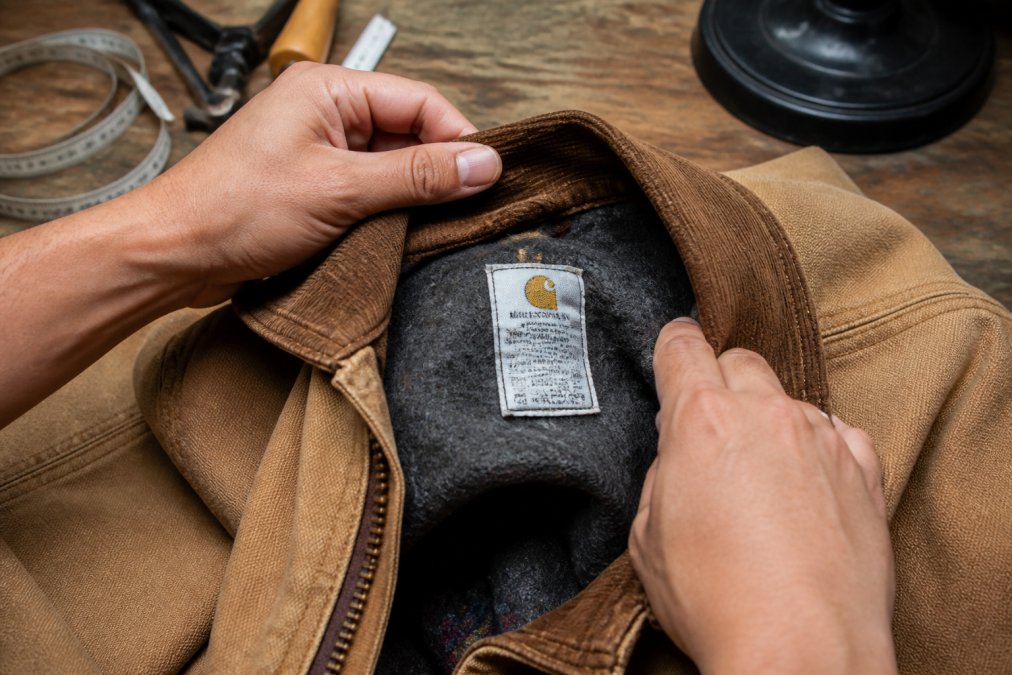
- How to Find the Internal Tag on Carhartt Jackets
- Decoding Carhartt Style Codes and Model Numbers
- Reading Production Dates from Tag Numbers
- The Visual Tag Evolution Timeline: 1970s to Today
- Identifying Material Composition Tags and Factory Origin
- Spotting Authentic Vintage Hardware and Zipper Pulls
- Counterfeit vs. Authentic: A Carhartt Checklist
- Vintage vs. Modern Workwear: What Changed and When
- How to Care for Vintage Workwear Without Damaging It
- Where to Find Authenticated Vintage Carhartt Pieces
- Conclusion
- Frequently Asked Questions
Last Updated: September 28, 2026
Why Carhartt Tag Decoding Matters for Buyers and Sellers
Dating vintage Carhartt workwear jackets starts with one small piece of fabric: the internal tag. That label carries the style number, the factory code, and often the season marking that tells you when a jacket was actually made. Without it, you are guessing. With it, you can price a piece accurately, spot a counterfeit, and know whether you are holding a 1980s Detroit jacket or a modern reissue.
This guide from AuthentiKickz walks through every tag type Carhartt has used, what the numbers mean, and how to read them in under a minute.
Here is the part most guides get wrong. They treat tag reading as a single skill. It is actually three separate ones: locating the tag, decoding the code, and cross-checking it against hardware and construction. Miss any of the three and you will misdate a jacket.
How to Find the Internal Tag on Carhartt Jackets
The main internal tag on a Carhartt jacket sits at the back of the neck, sewn into the collar seam. On older pieces it is a woven label; on newer ones it is often a printed neck label with no separate tag at all. If the neck tag is missing or faded, check the side seam and the interior hem before assuming the jacket is unidentifiable.
Carhartt has used several tag placements over the decades, and knowing where to look saves you from wrongly dismissing a genuine piece.
Common Tag Locations: Collar, Side Seam, and Hem
- Back neck: The primary tag. Holds the brand name, size, country of origin, and often the style number.
- Left side seam: Common on jackets from the 1990s onward. Usually a smaller care and fiber-content tag.
- Interior hem: Found on some lined jackets. Carries the same style and production codes as the neck tag.
- Inside pocket: Less common, but some Detroit and Chore coats place a secondary tag inside the chest pocket.
A jacket with no tag anywhere is not automatically fake. Tags fall off, and workwear gets worn hard.
Union-Made vs. Standard Labels
If a jacket carries a union label, it was made under a union contract, and Carhartt's union production era ended in the 1990s. That gives you a hard ceiling on the date. Union labels typically appear alongside the standard Carhartt tag, often in the side seam or next to the neck label.
Standard labels, meaning no union marking, can be from any era, so they tell you less on their own. When you see a union label, you know the jacket predates the mid-1990s. When you do not, you fall back on the style number and tag style.
Decoding Carhartt Style Codes and Model Numbers
A Carhartt style code is the alphanumeric string printed on the internal tag that identifies the exact garment model. It usually follows a pattern of letters and numbers, sometimes with a color code and a season marking attached. Reading it correctly tells you the model, the fit, and often the production window.
The codes look intimidating at first. They are not. Once you know the structure, you can decode a tag in seconds.
What the Letters and Numbers Actually Mean
Carhartt style codes generally break into three parts:
- The base model number. A four or five digit number identifying the garment. The K87, for example, is the classic pocket tee. Jacket models use their own numbering.
- The color or variant code. A short letter or letter-number combination that indicates the colorway.
- The season or production marking. Often a letter-plus-two-digit code, such as F17 for Fall 2017, or a numeric code tied to the factory batch.
A real example from our own inventory: a Carhartt K87-BLS pocket tee carries the style number K87-BLS on the care tag, with "Made in Honduras" and "Original Fit" printed on the neck label. That combination places it firmly in the modern era, and the printed neck label (rather than a woven one) confirms it.

For a full breakdown of how these codes vary by garment type, the Carhartt official product and brand information is the most reliable reference for current model numbering.
Reading Production Dates from Tag Numbers
Production dates on Carhartt tags come from a combination of the season marking and the factory code, not from a single printed date. Most jackets show a season-and-year code (like SPRING 2023 or F17) rather than a month and year. When you find both a season code and a factory origin, you can pin the production window to within roughly six months.
Here is how the pieces fit together:
| Tag Element | What It Tells You | Example |
|---|---|---|
| Style number | The exact model | K87-BLS, 102274 |
| Season code | Production season and year | SPRING 2023, F17 |
| Factory origin | Country of manufacture | Mexico, Honduras, Guatemala |
| RN number | Carhartt's registered ID | RN#14806 |
| P.O. number | Batch/production run | P.O. 3510027419 |
Carhartt's RN is 14806, and it appears on genuine tags across eras.
How the Season Code Actually Works
The season code is the part most buyers misread, because it is not a date on its own. It is a two-part signal: a letter or word for the selling season, and a two-digit year. The common pattern is F for Fall, S for Spring, and a plain two-digit year on some tags with no letter at all. So F17 reads as Fall 2017, and SPRING 2023 reads as the spring 2023 selling season.
Two things trip people up here. First, the selling season is not the production date. A Fall 2017 jacket may have been cut and sewn in the spring or summer of 2017 so it could ship to stores before the season. Treat the season code as a window, not a birthday. Second, some tags carry only a numeric batch reference with no season letter at all. When you see a string like "102274 475," the first number is the style and the second is the color or batch reference, not a date. Do not read the trailing digits as a year.
A Worked Example, Start to Finish
Take a tag reading: style 102274, color 475, RN#14806, country of origin Mexico, season code F17.
- The style number 102274 identifies the model, so you know what garment you are holding before you date it.
- The RN number 14806 confirms the tag is a genuine Carhartt registration.
- The country of origin, Mexico, is consistent with Carhartt's post-domestic production era, so you already know this is not a union-era piece.
- The season code F17 places the selling season in fall 2017, which puts actual production in the months before that.
Every clue points the same direction, which is what a confident date looks like. If the country of origin said one thing and the tag style said another, you would slow down and re-check.
When the Clues Disagree
A single mismatched clue is not proof of a fake, but it is a reason to look harder. The most common disagreements are a season code that is newer than the tag style, a country of origin that does not match the era the tag format suggests, and a P.O. number that looks printed rather than woven on a jacket claiming to be decades old.
Note that the country of origin shifts over time.
Carhartt Swisher Jeans Mens 38x30 Blue →
The Visual Tag Evolution Timeline: 1970s to Today
Tag design changed in recognizable stages, and this timeline is a way to place a jacket in the right decade before you even read the numbers.
- 1970s to 1980s: Woven labels, often with a simple Carhartt script logo. Union labels common. Minimal care information.
- 1990s: Woven labels persist, but care and fiber-content tags become standard. Union production winds down.
- 2000s: Printed neck labels begin replacing woven tags. Style numbers and season codes become more consistent.
- 2010s to today: Printed neck labels dominate. Tagless designs appear, with branding printed directly on the fabric. Season codes and P.O. numbers are standard.
Identifying Material Composition Tags and Factory Origin
Material composition tags tell you what the jacket is made of, and the fabric itself is a dating clue. Carhartt's signature duck canvas, firm-hand cotton, and later synthetic blends each map to different production eras.
- 100% cotton duck canvas: The classic heavy workwear fabric. Firm-hand duck is the traditional spec.
- Cotton-polyester blends: Became more common as production modernized.
- Performance fabrics: Force and similar lines use moisture-wicking blends, which are modern by definition.
Spotting Authentic Vintage Hardware and Zipper Pulls
Hardware is where counterfeits fall apart, and it is the check most buyers never run. Zippers, snaps, rivets, and buttons on genuine Carhartt carry specific branding and construction that fakes rarely match. This section names the actual parts to look at, because "check the hardware" is useless advice without knowing what you are checking for.

Zippers: Talon, YKK, and What the Pull Tells You
The zipper is the single most useful hardware clue, because zipper manufacturers changed over the decades and the brand name is usually stamped right on the pull or the slider.
- Talon: An American zipper maker whose pulls show up on older workwear. A Talon-stamped zipper on a heavy canvas jacket is a strong signal of an earlier production era, and it is one of the tells collectors look for first.
- YKK: The Japanese zipper maker that became the dominant supplier across the apparel industry. A YKK-stamped zipper is consistent with later production, so finding one on a jacket claiming to be from the 1970s is a contradiction worth investigating.
- Unbranded zippers: Genuine Carhartt jackets use branded zippers. A plain, unbranded zipper with no maker's stamp is a warning sign, especially on a jacket priced as vintage.
Snaps, Rivets, and Buttons
Carhartt logo snaps and rivets appear at stress points: the front placket, pocket corners, and cuff closures. On genuine pieces the branding is crisp, correctly proportioned, and centered. Blurry, off-center, or missing branding is a warning sign.
Stitching as a Hardware-Adjacent Check
Stitching is not hardware, but it belongs in the same pass because it is the tell that survives wear. Run your eye along a long seam and look for even spacing; irregular spacing is a signal.
The Cross-Check Rule
No single hardware detail proves a jacket is genuine. Verify the tag, the hardware, and the stitching together before you buy or price a piece. When all three agree on the same era, you can be confident. When they disagree, walk away or price the jacket as unverified.
Counterfeit vs. Authentic: A Carhartt Checklist
Use this checklist before you buy or sell any Carhartt jacket. It covers the four areas where fakes are most often caught.
- RN number: Does the tag show RN#14806 or the correct Carhartt registered number?
- Style number: Is the style code consistent with a known Carhartt model?
- Hardware: Are zippers, snaps, and rivets branded and period-correct?
- Stitching: Is the stitching dense, even, and double-needle at stress points?
- Tag style: Does the tag format match the era the jacket claims to be from?
- Fabric: Does the fiber content match the model and era?
- Country of origin: Is the origin consistent with Carhartt's production history?
- Logo patch: Is the Carhartt logo patch correctly proportioned and cleanly stitched?
Vintage vs. Modern Workwear: What Changed and When
Vintage and modern Carhartt are built differently, and the differences show up in the tags. Understanding what changed helps you date a piece and decide whether it is worth the premium that older workwear commands.
The biggest shifts:
- Union to non-union production. Union labels disappeared in the 1990s, making union-marked pieces genuinely older.
- Woven to printed tags. The move from woven labels to printed neck labels marks the modern era.
- Domestic to international production. Origin shifted from domestic factories to Mexico, Honduras, and Guatemala.
- Fabric changes. Traditional firm-hand duck gave way in some lines to lighter or blended fabrics.
How to Care for Vintage Workwear Without Damaging It
Caring for vintage workwear is different from caring for new garments, because aged fabric, old stitching, and original hardware are all more fragile than they look. The goal is to preserve, not to restore aggressively.
Practical rules that experienced collectors follow:
- Wash sparingly and cold. Hot water and frequent washing break down aged cotton fibers and accelerate fading.
- Skip the fabric softener. It coats the fabric and can damage the hand feel of firm duck canvas.
- Air dry. Heat from a dryer shrinks cotton and stresses old stitching.
- Spot clean first. Treat stains locally before committing the whole jacket to a wash.
- Store flat or on a wide hanger. Thin wire hangers distort the shoulders of heavy canvas over time.
Where to Find Authenticated Vintage Carhartt Pieces
The safest place to buy dated, verified Carhartt is a reseller who authenticates in-house and describes the tag details honestly. That is exactly what AuthentiKickz does: every piece is cleaned, inspected, and authenticated in-house, with accurate photography and honest descriptions.
- Carhartt Swisher Jeans (Men's 38x30, Blue Relaxed Fit): A classic five-pocket workwear denim with the interior style number 30553 and code S4A304 visible on the tag, plus the Carhartt leather logo patch on the back pocket.
- Carhartt Force Ridgefield Shirt (Men's 3XL, Green, New With Tags): A relaxed-fit button-up with tag references RIDGFD, RN14806, and 102418 391, ideal for anyone studying how modern style codes are structured.
- Carhartt K87-BLS Pocket Tee (Men's 4XL, Gray): The classic heavyweight workwear tee, with style K87-BLS and Original Fit printed on the neck label, a clean example of a modern tag layout.
- Carhartt Force Pocket Tee (Men's Small, Pink): A performance workwear shirt with RN#14806 and a seasonal tag reading SPRING 2023, showing exactly how a modern season code appears on a real tag.
Conclusion
Dating vintage Carhartt is a skill built on cross-checking, not on any single tag detail.

Frequently Asked Questions
How can I tell the age of my Carhartt jacket?
Start by locating the internal tag inside the collar or side seam. Look for the style code, usually a letter-number combination like C03 or J130. Check the care tag for a date code, often formatted as month/year. The Carhartt logo font and tag color also help: brown tags typically indicate pre-2000 production, while black and white tags are more recent. Cross-reference the style code with known production runs to narrow the window.
What do the numbers on Carhartt tags mean?
The numbers on Carhartt tags serve two purposes. The primary style number identifies the garment model, such as the Detroit Jacket or Chore Coat. A secondary code, often near the care instructions, indicates the production batch and date. For example, a tag reading 'C03' points to the Detroit Jacket, while a separate code like '0198' could mean January 1998. Learning Carhartt jacket style codes explained helps you match the number to the correct model and era.
Are older Carhartt jackets worth more than modern ones?
In many cases, yes. Pre-2000 Carhartt jackets made in the USA with union labels carry a premium among collectors. A 1980s Detroit Jacket in good condition can sell for several times its original retail price. However, condition matters more than age alone. Jackets with heavy distressing, missing hardware, or significant fading lose value. Deadstock examples with original tags command the highest prices. Modern Carhartt WIP pieces also hold value but for different reasons.
How do I identify a genuine vintage Carhartt jacket?
Check three things: the tag, the hardware, and the stitching. Authentic vintage Carhartt tags have clean, evenly spaced lettering with the correct logo font for the era. Zippers should be YKK or Talon with branded pulls. Stitching should be tight and consistent, with no loose threads or irregular patterns. Counterfeit tags often have blurry text, wrong font weights, or misspelled words. The interior care tag should list fabric composition and country of origin clearly.
What are the most common Carhartt jacket styles from the 90s?
The Detroit Jacket (style C03), Chore Coat (C01), and Active Jacket (J130) dominated the 1990s. The Detroit Jacket featured a corduroy collar and blanket lining. The Chore Coat was a heavier canvas work coat with four pockets. The Active Jacket, introduced in the late 90s, had a hood and rib-knit cuffs. These three models remain the most sought-after by collectors and are the easiest to date because their style codes stayed consistent through the decade.
Does the location of the tag change the date of the jacket?
Yes, tag placement is a dating clue. Pre-1980s Carhartt jackets typically had tags sewn into the collar or at the side seam near the hem. From the 1990s onward, most tags moved to the inside back neck area. Some 2000s models have tags printed directly onto the fabric rather than sewn. If you find a collar tag on a jacket claiming to be from the 2000s, that is a red flag for authenticity.
How should I clean a vintage Carhartt jacket without ruining it?
Spot clean with cold water and mild detergent first. For deeper cleaning, hand wash in cold water and hang dry away from direct sunlight. Avoid machine washing vintage duck canvas, as agitation breaks down the fabric and fades the color. Never use bleach or fabric softener. If the jacket has leather patches, cover them before washing. For heavy soiling, take it to a professional cleaner experienced with vintage workwear.
If you want to skip the guesswork entirely, AuthentiKickz authenticates and grades every piece in-house, photographs the actual tags, and describes each item honestly so you know exactly what you are buying. With fair pricing, fast tracked shipping, and a catalog that runs from everyday workwear to kids' sizes, we make it easy to buy with confidence. Get started with AuthentiKickz and build a wardrobe you can actually trust.