

How to Tell If Sneakers Are Authentic: 2026 Guide
Table of Contents
- Why Sneaker Authentication Matters More Than Ever in 2026
-
Your Sneaker Legit Check Guide: 8 Physical Inspection Steps
- Step 1: Inspect the Box and Packaging Integrity
- Step 2: Check the Size Tag, SKU Number, and Font Consistency
- Step 3: Evaluate Stitching, Eyelet Alignment, and Material Quality
- Step 4: Analyze Midsole, Outsole, and Sole Density
- Step 5: Examine Tongue Label, Heel Tab, and Insole Print
- Step 6: Run the Smell Test and Weigh the Shoes
- Step 7: Compare Against Verified Retail Pairs
- Step 8: Use a UV Light Test for Hidden Markings
- Common Signs of Counterfeit Shoes You Should Never Ignore
- Best Sneaker Authentication Apps and Digital Verification Tools
- Replica vs. Unauthorized: Why the Distinction Changes Everything
- DIY Macro-Photography: How to Document Flaws Like a Pro
- High-Risk Models: A Checklist for the Most Faked Sneakers
- When to Trust a Professional Authentication Service
- Frequently Asked Questions
Last Updated: September 10, 2026
Why Sneaker Authentication Matters More Than Ever in 2026
Counterfeit operations now replicate a sneaker's silhouette in weeks (oecd.org). Learning how to tell if sneakers are authentic is no longer optional collector knowledge, it's basic self-defense.
This guide walks through the physical inspection process.
Your Sneaker Legit Check Guide: 8 Physical Inspection Steps
A sneaker legit check is a systematic physical inspection of a shoe's construction, materials, and labeling to determine whether it was produced by the brand it claims to represent. Work from the outside in.
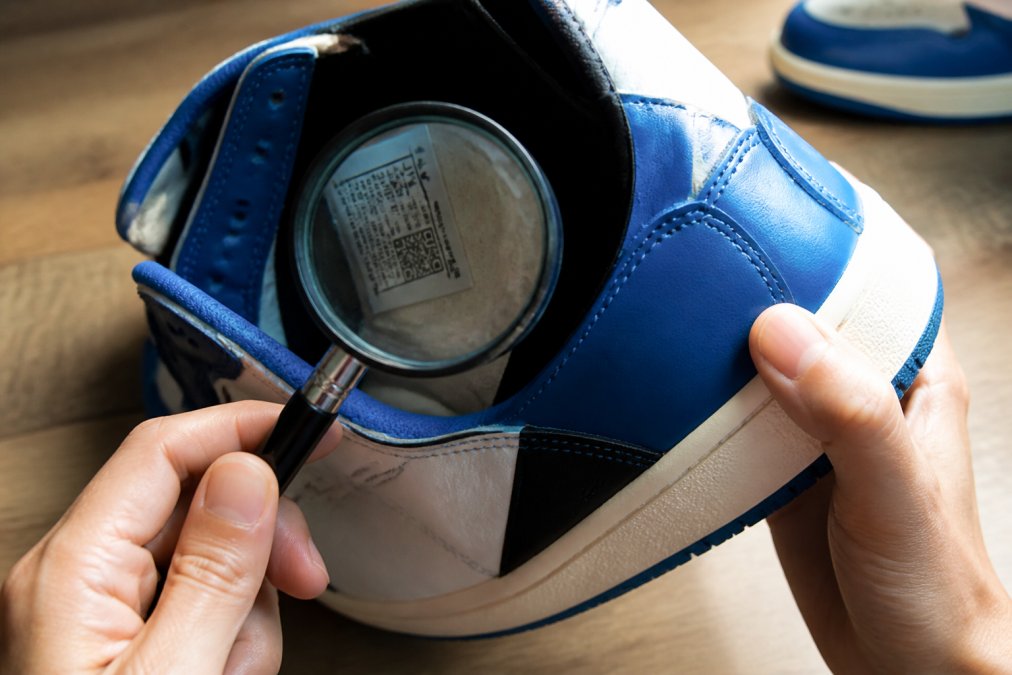
Step 1: Inspect the Box and Packaging Integrity
Counterfeits often ship in packaging that's close but not exact. Check the box label's font weight, spacing, and alignment against a verified retail pair; mismatched label stock or a missing retail sticker is a red flag. The label should match the shoe's size, colorway, and SKU exactly.
Step 2: Check the Size Tag, SKU Number, and Font Consistency
The size tag is where most fakes fail. Genuine tags use consistent fonts with no blurriness or uneven kerning. Verify the SKU matches the box label and style code, and that the production date falls within a plausible window.
Step 3: Evaluate Stitching, Eyelet Alignment, and Material Quality
Stitching tells you more than any single label. Genuine pairs have even stitch density, clean thread tension, and mirrored eyelet alignment; loose threads, skipped stitches, or uneven eyelets suggest replica flaws. Premium leather has a natural grain and soft hand-feel; synthetics feel uniformly smooth and plastic.
Step 4: Analyze Midsole, Outsole, and Sole Density
Midsoles and outsoles are harder to fake than uppers because they require specific molds and foam compounds. Genuine foam returns slowly and evenly when pressed; replicas feel too firm or too spongy. Compare the outsole tread pattern against official images, checking groove depth and sharpness.
Step 5: Examine Tongue Label, Heel Tab, and Insole Print
The tongue label and insole print carry brand-specific details counterfeiters often get wrong. Heel tab embossing should feel crisp, not flat. Insole print should be sharp with no smudging. Check that the tongue label's logo proportions match the brand's current branding, since fakes often reuse older molds.
Step 6: Run the Smell Test and Weigh the Shoes
New sneakers smell of leather, adhesive, and rubber; counterfeits often reek of chemical solvents or glue. Weigh both shoes against the manufacturer's stated weight or a verified retail pair, this catches fakes using heavier, cheaper midsole materials.
Step 7: Compare Against Verified Retail Pairs
Side-by-side comparison remains the most reliable method. Place your pair next to a verified retail pair of the same colorway and size, then check toe box shape, heel tab angle, and overall proportions.
Step 8: Use a UV Light Test for Hidden Markings
Many brands embed UV-reactive markings inside the shoe or on the size tag, which counterfeits rarely replicate (uspto.gov). Shine a UV light across the tongue label, insole, and heel. Genuine markings glow; fakes show nothing or glow inconsistently.
| Step | What to Check | Red Flag |
|---|---|---|
| 1 | Box label and packaging | Mismatched label stock |
| 2 | Size tag and SKU number | Blurry or inconsistent font |
| 3 | Stitching and eyelets | Uneven stitch density |
| 4 | Midsole and outsole | Inconsistent sole density |
| 5 | Tongue label and insole | Smudged print, flat embossing |
| 6 | Smell and weight | Chemical odor, wrong weight |
| 7 | Retail pair comparison | Proportion deviations |
| 8 | UV light test | Missing hidden markings |
Common Signs of Counterfeit Shoes You Should Never Ignore
The clearest signs of counterfeit shoes cluster around labeling, construction, and materials. One issue might be a manufacturing defect; three or more together almost always indicate a fake.
Watch for glue stains along the midsole seam, perforation patterns that don't align between shoes, and unevenly spaced eyelets. Heel tab stitching is often the first area to show sloppy replica work.
Best Sneaker Authentication Apps and Digital Verification Tools
Digital tools speed up the process but work best as a second opinion, not a replacement for physical inspection. The category splits into three tiers, and knowing the difference tells you how much weight to give a verdict.
Tier 1: Photo-Upload Authentication Apps
You photograph the size tag, box label, tongue, heel, and outsole, upload them, and the app compares your images against a database of verified retail pairs, returning a confidence score.
These apps are pattern-matching engines, not experts. The reference database determines verdict quality, a thin database for an obscure colorway is unreliable, and photo quality is everything. Blurry images, bad lighting, or wrong angles produce wrong answers, and the app won't flag bad input.
Treat any app verdict as one data point, not a final answer, especially on high-value pairs.
Tier 2: Human-Backed Authentication Services
These combine trained inspectors with reference databases and, at higher tiers, physical inspection. You ship the pair in or submit detailed photos, and a human reviews it. The trade-off is time and cost: most take several days, and fees are typically non-refundable even if the shoe is fake.
Human-backed services are worth it when stakes are high, a rare pair, high resale value, or an unknown seller. For everyday purchases, the eight-step inspection above catches the vast majority of counterfeits.
Tier 3: Hardware and Digital Verification (NFC, Blockchain, and Embedded Tags)
Some brands and resale platforms embed verification hardware directly into the product:
- NFC chips: A small chip embedded in the tongue or under the insole can be scanned with a smartphone, returning a unique identifier tied to a production record. The catch: a chip proves the tag is genuine, not the shoe, chips can be harvested from genuine pairs and transplanted into fakes, so treat an NFC scan as one signal among many.
- Blockchain-backed digital twins: Some platforms issue a digital certificate tied to a specific pair at the point of sale, recorded on a ledger. When the shoe resells, the certificate travels with it. This is powerful for provenance but only works if the original sale was registered, an unregistered pair has no digital twin to check.
- QR-coded authenticity tags: Common on limited drops. Scan the QR code and it should resolve to a brand-controlled page showing the product record. A code that resolves to a generic page, a dead link, or a third-party site is a red flag.
How to Scan a Sneaker to See If It's Original
To scan a sneaker, photograph the size tag, box label, tongue label, heel tab, and outsole in bright, even lighting, then upload them to an authentication app or professional service. Keep the shoe steady, fill the frame with the detail, and avoid shadows over text. Most services want five to seven photos; follow requested angles exactly, since deviation is the top reason scans come back inconclusive.
For NFC or QR verification, hold your phone steady against the tag, wait for the read, then confirm the record matches the shoe's size, colorway, and production date. A mismatch is a stronger red flag than a missing chip, it suggests the tag was transplanted.
Replica vs. Unauthorized: Why the Distinction Changes Everything
Not every unauthentic shoe is a counterfeit, and the difference matters for risk. A replica is an intentional copy made to deceive a buyer (uspto.gov). An unauthorized pair comes from the same factories, often with the same materials and patterns, but without the brand's authorization or quality control.
Unauthorized pairs can pass many physical checks because they come from the same production lines; what they lack is the brand's final inspection, consistent quality control, and official distribution. Ask the seller directly which category the shoe falls into, one who can't or won't answer is worth avoiding.
DIY Macro-Photography: How to Document Flaws Like a Pro
You don't need a professional camera, a phone with macro mode or a cheap clip-on macro lens works. The goal is enough detail that a stranger could evaluate the shoe from your photos alone.
Set up near a window with indirect daylight, direct sunlight blows out highlights and hides texture. Place the shoe on a neutral surface. Fill the frame with one detail per photo: size tag, toe box stitching, heel tab, insole print. Take three shots per detail at slightly different angles; this set gives an authentication service everything it needs.
High-Risk Models: A Checklist for the Most Faked Sneakers
Most authentication guides give one universal checklist and stop there. That's a mistake, counterfeiters specialize. A factory that nails a retro basketball high-top often botches a knit runner, and vice versa. Run the general eight-step inspection, then layer on a model-specific checklist for whatever you're buying.
Below are the categories that attract the most counterfeiting pressure and the details worth slowing down for.
Retro Basketball High-Tops
The most counterfeited category: resale premiums stay high and the silhouettes are simple to mold. When inspecting a pair:
- Wings logo or ankle emblem: On genuine pairs the embossing is deep and crisp, with a defined edge. Fakes tend to be shallow, soft, or slightly oversized.
- Toe box perforations: Count them. The number and spacing should match exactly between left and right shoe, and the holes should be punched cleanly, not ragged.
- Heel shape: Genuine heel counters curve inward slightly at the top. Replicas often sit too straight or flare outward.
- Midsole paint line: The line where the midsole meets the upper should be sharp and consistent. Fuzzy or wavy paint lines are a common factory flaw.
Knit and Flyknit-Style Runners
Knit uppers are hard to fake because the weave pattern is engineered, not printed. Look for:
- Weave density zones: Genuine knit uppers change density in specific areas (tighter at the midfoot, looser at the toe). Fakes usually use a uniform weave throughout.
- Heel counter rigidity: Press the back of the heel. It should hold its shape firmly. Replicas often collapse or feel mushy.
- Sockliner fit: The insole should sit flush with no gaps or wrinkles around the edges.
Limited Collaborations and Designer Drops
Collabs are the highest-risk category per pair: the resale premium is steepest and production runs are small, so fewer reference pairs exist. For these:
- Demand the original box, receipt, and any authentication documentation before you commit.
- Check the collaboration-specific branding (co-branded tongue tags, custom insoles, special packaging) against official press images, not reseller photos.
- Verify the production date window. Collab drops have narrow production windows; a tag dated outside that window is a red flag.
Anniversary Reissues and Retro Runners
Reissues reuse older molds, making them easier to copy. The tell is usually in the details the brand updated:
- Font on the tongue label: Reissues often update typography. Compare against the current official product page, not an old photo.
- Stitching on the heel tab: This is typically the first area to show sloppy work on replicas.
- Outsole tread depth: Measure the groove depth with a fingernail. Shallow, rounded grooves indicate a worn or cheap mold.
Any Pair With a Resale Premium Above Retail
The simplest rule in this guide: the higher the premium, the higher the counterfeiting incentive. If a pair sells well above retail, assume it's a target and run the full inspection plus the model-specific checks above.
Pairs Sold Without Original Packaging or Receipts
A missing box isn't proof of a fake, plenty of legitimate owners toss packaging, but it removes a layer of verification, shifting the burden of proof onto the shoe. Insist on detailed photos of the size tag, box label (if available), tongue, heel, and outsole before committing, and treat seller hesitation as a signal.
When to Trust a Professional Authentication Service
Professional authentication services are worth the cost when stakes are high: a rare pair, high resale value, or an unknown seller. They combine trained human inspectors with reference databases and, in some cases, physical inspection.
The trade-off is time and cost: most take several days, and fees are non-refundable even if the shoe is fake. For everyday purchases, the eight-step inspection above catches the vast majority of counterfeits. For anything you'd hate to lose money on, pay for the professional check.
At AuthentiKickz, every item is cleaned, inspected, and authenticated in-house before it's listed, which is why we can offer fair pricing without inflating for hype. If you'd rather skip the guesswork entirely, browse our current inventory.
Counterfeit sneakers get better every year, and the gap between genuine and convincing fakes keeps narrowing. The eight-step process above won't catch every fake, but it catches the vast majority and teaches you what to look for over time. AuthentiKickz authenticates and grades every item in-house, ships within one to two business days with tracking on every order, and prices fairly without hype markups. Shop sneakers you can actually trust.
Frequently Asked Questions
What are the most faked sneakers?
The most counterfeited models are consistently Nike Air Jordan 1 and 4, Yeezy Boost 350, and Nike Dunk Low. These models have massive resale demand and recognizable silhouettes, making them prime targets. When learning how to tell if sneakers are authentic, start by studying these high-risk models. Counterfeiters invest most in replicating popular colorways, so pay extra attention to stitching patterns, midsole shape, and tongue label fonts on these pairs.
Is there an app to check sneakers authenticity?
Yes, several apps use AI and crowd-sourced data to help verify sneakers. CheckCheck and Legit App are two of the best sneaker authentication apps. You upload photos of key areas like the size tag, midsole, and heel, and human authenticators or algorithms review them. These tools work best as a supplement to physical inspection, not a replacement. Always combine app results with your own sneaker legit check guide steps before buying.
How to scan a sneaker to see if it's original?
Scanning a sneaker typically involves using a smartphone app to photograph specific zones: the size tag, box label, midsole stitching, and tongue. Some brands embed QR codes or NFC chips in newer models. Scan the QR code with your phone's camera to check if it links to the brand's official verification page. If the code redirects to a generic site or fails to load, that's a red flag. Pair digital scans with physical checks for the best results.
Can a Nike QR Code tell me if shoes are real?
A Nike QR code can help, but it's not foolproof. Authentic Nike pairs made after 2019 often include a QR code inside the tongue or on the box label. Scanning it should lead to Nike's official product page. However, counterfeiters have learned to copy QR codes, sometimes linking to convincing fake pages. Use the QR code as one data point among many. Check font consistency, stitching, and material quality alongside any digital verification.
What are the common red flags of fake sneakers?
Common signs of counterfeit shoes include glue stains along the midsole, uneven stitching, misaligned eyelets, and blurry or misspelled text on labels. The box label may have wrong SKU numbers or inconsistent fonts. Fake pairs often smell strongly of chemicals rather than leather or rubber. Weight is another clue: counterfeit shoes frequently feel lighter or heavier than retail pairs. If you spot two or more of these issues, walk away.
How do I authenticate sneakers without an app?
You can authenticate sneakers manually by following a sneaker legit check guide. Start with the box: check packaging integrity, label fonts, and SKU numbers. Move to the shoe: inspect stitching density, eyelet alignment, midsole paint, and tongue label print. Compare the pair against verified retail photos online. Weigh the shoes and check for glue stains. A UV light test can reveal hidden markings or inconsistencies. Practice on known-authentic pairs to train your eye.
What is the difference between replica and unauthorized sneakers?
Replica sneakers are outright counterfeits made to imitate a brand without permission. Unauthorized sneakers are made in the same factories as legitimate pairs but sold outside the brand's approved channels, sometimes called 'backdoor' pairs. Unauthorized pairs may use real materials and patterns but lack official quality control. Both are problematic for buyers. Replicas are always fake. Unauthorized pairs exist in a legal gray area but are not considered authentic by the brand.
Should I use a professional authentication service?
Professional authentication services are worth it for high-value purchases, especially limited drops or rare colorways. These services employ trained authenticators who inspect physical pairs or detailed photo sets. They catch flaws that apps and casual buyers miss, like incorrect sole density or subtle font inconsistencies. For sneakers over a few hundred dollars, the cost of authentication is small compared to the risk of buying a counterfeit. Always request a certificate of authenticity.